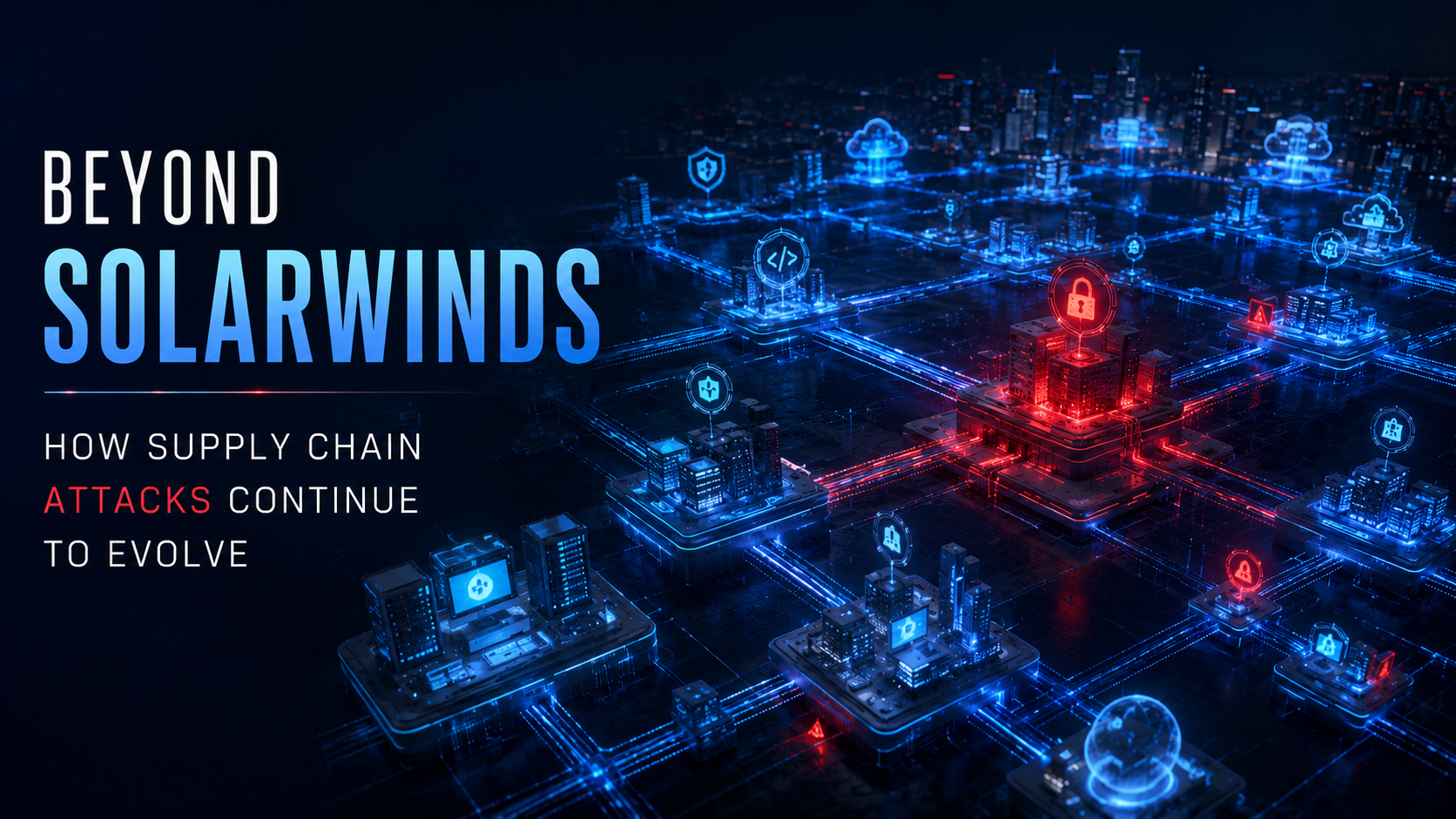
Beyond SolarWinds: How Supply Chain Attacks Continue to Evolve
June 8, 2026 • Tom Abuta
Introduction
In December 2020, the SolarWinds compromise fundamentally altered how organizations think about cybersecurity. The attack demonstrated that trusted software updates could become attack vectors, allowing adversaries to infiltrate highly secured environment through legitimate channels. While Solar winds became the defining software supply chain attack of its era, focusing solely on that incident risks obscuring a more important reality, supply chain attacks have evolved significantly since then.
OWASP Top 10:2025 Release ranks Software Supply chain Failures as the third most critical web application security risk. This is a remarkable rise for a threat category that was barely on the radar a decade ago. Since its introduction in the OWASP top 10 in 2013 supply chain has evolved from a niche concern into one of the industry’s pressing challenges. A survey in the top 10 community shows 50% of the respondents rank supply chain attack at number 1.
So, what makes software supply chain attacks so dangerous? Why do organizations continue to fall victim to them despite advances in security tooling and practices? Understanding the answers to these questions is key to defending modern applications.
What Makes Software Supply Chain Attack Dangerous
Supply chain greatly differs from traditional third-party compromise in both their execution and impact. While both exploit trusted relationships, software supply chain attacks target the very foundation on which applications are built.
They Compromise the Product Before it Reaches the customer.
Supply chain attacks take a more insidious approach by compromising software libraries, dependencies, build systems or update mechanisms before the software is distributed. This means organizations can unknowingly deploy malicious code that appears legitimate because it originates from a trusted source. Security teams may diligently patch systems, monitor networks and enforce access controls, yet still introduce compromised software into their environments through routine updates and dependencies installations.
They Exploit Trust at The Deepest Level
Developers trust open-source packages, organization trust software vendors and users trust updates delivered through official channels. Supply chain attacks weaponize this trust.
One malicious code embedded into trusted package it often bypasses traditional security controls because it is treated as legitimate software rather than suspicious activity.
The ability to hide within trusted software makes supply chain attacks difficult to detect and increases their success rate significantly.
The Domino effect of a single breach
One of the most dangerous characteristics of a software supply chain attacks is their scalability.
The 2020 SolarWinds Orion breach enabled hackers insert malicious code and distributed as legitimate software update to over 18000 customers including U.S government agencies and fortune 500 corporations.
This one-to-many attack model gives adversaries an unprecedented return on investment. A single successful compromise can create a ripple effect across industries, governments and critical infrastructure.
Modern Software Ecosystems Amplify the risks
JetBrains a major software company that creates tools for computer programmers was breached. A significant vulnerability in TeamCity servers widely used to do continuous Integration/Continuous Deployment (CI/CD) was exploited by attackers facilitating supply chain attack.
Development teams rarely build every feature from scratch and depend on external libraries, frameworks container images, package repositories, CI/CD platforms and cloud services.
This limited visibility into security posture of every dependency within their software stack expands the attack surface dramatically.
Security experts caution that this attack vector is not slowing down anytime soon. It is widely regarded as one of the key threat organizations must be prepared for in 2026 and beyond.
The question then becomes what can organizations actually do to defend against it?
Software Supply Chain Security Controls Every Organizations Needs
1. Secure the development environment
The development environment is the first trust boundary in the software supply chain. If it is compromised, every downstream control becomes ineffective.
Organizations need to enforce strict controls so that only authorized personnel can access source code repositories, development tools and sensitive configuration systems. Strong authentication mechanism such as multi-factor authentication and hardware-backed identity should be standard.
Equally important is the protection of sensitive development data, including source code, API keys and signing credentials. These assets must be encrypted both at rest and in transit to reduce exposure in the event of compromise.
Finally, development tools, libraries and IDEs should be continuously updated and patched. Outdated tooling is a frequent entry point for attackers seeking to exploit known vulnerabilities in developer workflows.
2. Secure the Build Pipeline
The CI/CD pipeline has become one of the highest value targets in modern supply chain attacks because it represents the automation layer that transforms source code into production software.
Securing this pipeline requires strict access control and separation of duties to ensure no single actor can modify code, build configurations and release artifacts without oversight.
Implementing logging, auditing and continuous monitoring across all pipelines stages to detect unauthorized or unusual activity. Any modification to build process can be independently verified and has not been tampered with.
Regular security assessments of CI/CD infrastructure are essential, as attackers increasingly target these systems to inject malicious code before deployment.
3. Vet Third Parties
Before integrating third-party components, organizations should perform a structured security assessments of vendors and libraries. This includes reviewing their vulnerability management practices, update frequency, incident history and security posture.Components should be scanned for known vulnerabilities prior to adoption and continuously monitored throughout their lifecycle. Dependencies should not be treated as static but as evolving risk elements.
4. Utilize Software Composition Analysis Tools
Visibility is critical to understand what you are protecting against. Software Composition analysis tools automatically scan code bases to identify dependencies, map them to known vulnerabilities and highlight potential security risks based on versioning and usage context. They go beyond detection and provide remediation guidance, helping development teams prioritize fixes based on exploitability and business impact.
5. Implement a software Bill of Material (SBOM)
SBOM serves as the foundational artifact for supply chain transparence. It provides a structured inventory of all components within a software product including open-source libraries, propriety modules and transitive dependencies.
It enables organizations to rapidly assess exposure when new vulnerabilities are disclosed significantly reducing the time required for impact analysis and remediation. However, SBOMs need to be updated continuously, integrated into vulnerability management and incident response process for maximum utility.
6. Use Security Information and Event Management (SIEM)
By aggregating logs from development systems CI/CD pipelines, cloud infrastructure, and runtime environments, SIEM platforms enable organizations to detect anomalous behavior that may indicate a supply chain compromise. When properly configured and quality telemetry collected, organization’s ability to detect and respond to supply chain attacks in near real time is greatly enhanced.
Conclusions
These controls reflect a shift. Supply chain security is no longer about protecting isolated systems. With the evolving paradigms it is more importantly about securing the entire software production ecosystem, from code creation to deployment and runtime monitoring.Organizations that adopt this layered approach move from reactive vulnerability management to proactive supply chain assurance significantly reducing exposure to modern attack techniques.
Ready to assess your organization's Security Posture? Let us talk.
Telephone: +254 728223333
Email: cybersecurity@southendtech.coke | info@southendtech.co.ke | dataprotection@southendtech.co.ke | cybersecurity@southendtech.co.ke
South-End Tech Limited — Helping businesses build visible and Cyber-resilient Enterprises